


EFAMA appreciates the opportunity to share our views on the European Commission’s consultation on enhancements to the suitability and appropriateness assessments forming part of the wider, upcoming Retail Investment Strategy.






EFAMA appreciates the opportunity to share our views on the European Commission’s consultation on enhancements to the suitability and appropriateness assessments forming part of the wider, upcoming Retail Investment Strategy.

The European Fund and Asset Management Association (EFAMA) has today published its International Quarterly Statistical Release regarding the developments in the worldwide investment fund industry during the fourth quarter of 2021.

The European ESG Template (EET) is meant to facilitate the necessary exchange of data between product manufacturer and distributor for the purpose of fulfilling ESG-related regulatory requirements contained in the SFDR, relevant provisions of the Taxonomy Regulation, and the relevant delegated acts complementing MiFID II and IDD. The EET V1 is based on the regulatory situation on the day of publication and will be reviewed regularly depending on the evolving regulation, and at least confirmed annually. With regard to the MiFID target market, the EET interacts with the EMT V4.
EFAMA released today issue number eight of its Market Insights series titled 'The Costs of UCITS and US Mutual Funds - We can only compare like with like'. This

We welcome the targeted approach of the Commission in its review, recognising the overall success of the frameworks over the past decade.
On behalf of:
CDP, Economy for the Common Good, EFAMA, Eurosif, Frank Bold, Finance Watch, Global Witness, Investor Alliance for Human Rights, Publish What You Pay, ShareAction, Transport and Environment, WWF
Dear Members of the European Parliament,

European Fund trends in Q4 2021 – Further slowdown in the net sales of long-term UCITS

The European Fund and Asset Management Association (EFAMA) has today published its latest monthly Investment Fund Industry Fact Sheet, which provides net sales data on UCITS and AIFs for December 2021, at European level and by country of fund domiciliation. A first overview of the net sales data of UCITS and AIFs over the full year 2021 is also included.



EFAMA replied to IASB’s request for information on the Post-Implementation Review (PIR) of IFRS 9 – Classification and measurement. Our paper recaps EFAMA’s key concerns and recommendations to the IASB. The key concerns of the industry are the removal of recycling (in particular for institutional investors) and the classification of investment entities and investment funds as debt instruments.

We commend the work that IOSCO has undertaken to date on this topic including the survey work and the summary findings in the form of the report currently under review. It is fair to say that the conclusions of the report and areas for further work gave rise to detailed discussions within our industry, yielding ultimately firm views on the priority areas that we support and see value in, and areas we felt were not reflected in the study and thereby building risk into margining models in future crisis scenarios. These areas are fur

For asset managers the main issue continues to be the reclassification of ETDs as OTCs as a result of the non-equivalence of UK regulated markets. While we understand that a review is legally mandated at this point in time, we do not see value in recalibrating the various thresholds or making changes to the calculation methodologies unless these are in the two areas we define below. Our main concern revolves around the fact that changes would carry significant compliance costs while making little impact on the population of counterparties and notional captured by the thresholds.
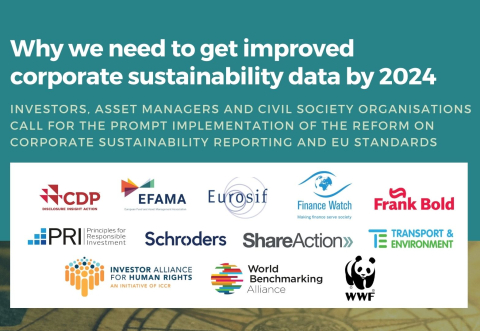
Investors, asset managers and civil society organisations call for the prompt implementation of the reform on corporate sustainability reporting and EU standards


This is a timely and necessary review to which we hope to contribute in a constructive manner. As already recognised in the consultation paper and in the MiFID Quick Fix proposal, RTS 27 and RTS 28 currently fall short of the objective of providing valuable and comparable datasets for investment managers and the investing public. We appreciate the present effort to revise reporting requirements to produce more meaningful reports.
Discover the 6 reasons why your organisation should become a member of EFAMA.
Our members enjoy significant benefits including the opportunity to shape the industry positions, get first-hand access to regulatory and political intelligence, engage with industry peers and policymakers, and take part in EFAMA events.
Our three membership categories cater to the wide range of organisations that make up and support the investment management industry in Europe.